Skip to content Skip to footer

Faculty of Materials Science and Ceramics

Information about studies for international students is available in the Department for International Students
international.students(at)agh.edu.pl

Contact for the Dean's Office of the Faculty of Materials Science and Ceramics at AGH: swimic(at)agh.edu.pl 

Faculty of Materials Science and Ceramics is a faculty with traditions focused on development.

Currently, the Faculty of Materials Science and Ceramics at AGH University of Krakow has nearly 480 students and 99 doctoral candidates. Additionally, postgraduate studies expanding knowledge are organized annually.

The Faculty's scientific and research activities cover a broad spectrum of topics, ranging from large-scale industrial technologies for traditional ceramic materials and their latest generations to advanced materials, including nano- and microscale structures, for various industries (construction, energy, aerospace, fuel, and computing). The research also involves the latest analytical and investigative techniques.


The scientific and research activities of the Faculty cover a very wide range of topics, from large-scale industrial technologies of traditional ceramic materials and their latest generations, to advanced materials, including at the nano and micro scale, for the needs of various industries (construction, energy, aerospace, fuel, computer) and the latest research and analytical techniques.


Research

Faculty of Materials Science and Ceramics

Faculty of Materials Science and Ceramics has a very rich research portfolio carried out in individual departments as well as accredited laboratories.

It conducts scientific and research activities in the field of chemistry and modern material technologies. 

Thanks to its modern infrastructure and technology, the department trains outstanding specialists who are appreciated at home and abroad.

Research staff and doctoral students conduct research and implement prestigious grants for which they are awarded internationally.
 

Research

Faculty of Materials Science and Ceramics

The growing demand for materials, biomaterials, i.e. materials for medicine, as well as the development of industries and technologies that use various types of composite materials,

makes the research work carried out extremely necessary and interesting.

Moving in such intensively developing fields of knowledge and engineering forces researchers to constantly develop and improve their skills and workshop.


The researchers' work focuses, among other things, on obtaining and evaluating the properties of biomaterials and composites, and the search for new solutions,

materials or ways to modify currently existing materials to improve their functionality and usability in both medicine and industry is ongoing.


Key research areas

We conduct advanced scientific research and implement innovative R&D projects in the fields of materials engineering, chemical technology, ceramics, nanotechnology, and materials science.

Our research teams focus on developing and advancing new materials and technologies for various industries. We work across all eight stages of the material “life cycle”: 

  • Design
  • Manufacturing (various technologies)
  • Modification (e.g., surface treatment)
  • Characterization (composition, structure, microstructure, etc.)
  • Property assessment (physicochemical properties)
  • Testing (application-oriented)
  • Application
  • Disposal/Recycling

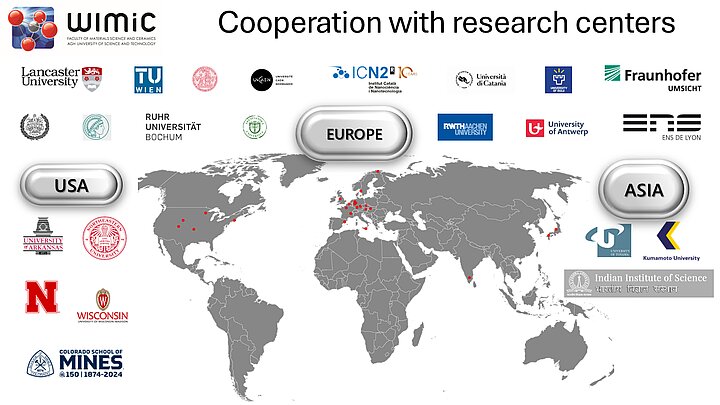
This is made possible by our state-of-the-art research infrastructure, the high expertise and experience of our staff, and our well-established national and international collaborations in both academia and industry.

We invite you to collaborate with our faculty in scientific and industrial partnerships, where innovation and a pioneering approach to materials science are the foundation of our research activities. The key research area of Faculty are as follows:

  • Traditional and advanced ceramics, refractory materials 
  • Construction materials 
  • Glass and amorphous coatings 
  • Biomaterials 
  • Composites, polymers, and carbon materials 
  • Analytical chemistry and biochemistry 
  • Physicochemistry and process modeling 
  • Inorganic chemistry, including solid-state photo- and electrochemistry 
  • Silicate chemistry and macromolecular compounds 
  • Functional materials 
  • Materials for energy conversion
Faculty’s research infrastructure

  • Thermophysical Research Laboratories
  • Scanning Electron Microscopy and Microanalysis Laboratory
  • Microstructural Research Laboratories
  • Structural Research Laboratory (FT-IR, Raman Spectroscopy, AFM, XRD)
  • Construction and Ceramic Materials Testing Laboratory (including Accredited Laboratory AB619)
  • Electrochemistry, Electroanalysis, and Solid-State Physicochemistry Laboratories
  • High-Temperature Processes Laboratories
  • Technological Laboratories for Advanced Building Materials and Mineral Binders
  • Transport Properties and Energy Conversion Research Laboratories
  • And many more.

For a full overview of the Faculty's equipment capabilities, we encourage you to contact us directly


Graduates of the Faculty of Materials Science and Ceramics at AGH


Graduates of the Faculty of Materials Science and Ceramics at AGH, are specialists in materials technology traditionally associated with the broader industries:

  • ceramics,
  • glass,
  • building materials,
  • refractory materials.


They are also successful in the design, manufacture and testing of new materials and components for specific applications in many cutting-edge areas (e.g., electronics, energy, aerospace, automotive, photonics, IT industry) and materials for medicine and environmental protection, as well as analytics and quality control.


Graduates are very well equipped to meet the challenges of the era of Industry 4.0.


The educational offer includes 6 fields of study in:

The Faculty of Materials Science and Ceramics at AGH also offers doctoral studies.

Stopka